Understanding Frozen Shoulder: Causes, Phases, and Relief at Hello Osteo
Written by Maëva Loyson

Is Your Shoulder Feeling "Frozen"?
Have you noticed a deep, nagging ache in your shoulder when reaching into the backseat of your car, putting on a jacket, fastening your seatbelt, or reaching for something on a high shelf? Has the stiffness gradually worsened until even everyday movements feel difficult?
If so, you may be experiencing Frozen Shoulder, medically known as Adhesive Capsulitis.
Frozen shoulder is a common condition that causes pain, stiffness, and a progressive loss of shoulder movement. Left untreated, it can significantly affect your daily life, making simple activities like dressing, driving, sleeping, or lifting objects frustrating and painful.
The good news is that while recovery takes time, the right treatment and guidance can help reduce pain, improve movement, and support your body's natural healing process.
At Hello Osteo, we take a whole-body approach to helping people regain mobility and return to the activities they enjoy.
What Is Frozen Shoulder?
Your shoulder is one of the most mobile joints in your body. It works like a ball-and-socket joint, surrounded by a flexible capsule of connective tissue that allows your arm to move freely in almost every direction.
With Adhesive Capsulitis, this capsule becomes inflamed before gradually thickening and tightening. Scar tissue, known as adhesions, develops inside the joint capsule, reducing the available space for movement and making even small motions painful.
As the capsule stiffens, your shoulder gradually loses both active and passive range of motion, giving the condition its well-known name: Frozen Shoulder.
What Causes Frozen Shoulder?
The exact cause isn't always clear, but several factors increase the likelihood of developing frozen shoulder.
You may be at greater risk if you:
- Are between 40 and 60 years old
- Are female (women are affected more frequently than men)
- Have diabetes, which significantly increases your risk
- Have thyroid disorders such as hypothyroidism or hyperthyroidism
- Recently experienced a shoulder injury or fracture
- Have undergone shoulder or breast surgery
- Needed to keep your shoulder immobilized for an extended period
- Have previously experienced frozen shoulder in your opposite shoulder
The Three Stages of Frozen Shoulder
Frozen shoulder typically develops slowly over time and progresses through three distinct phases.
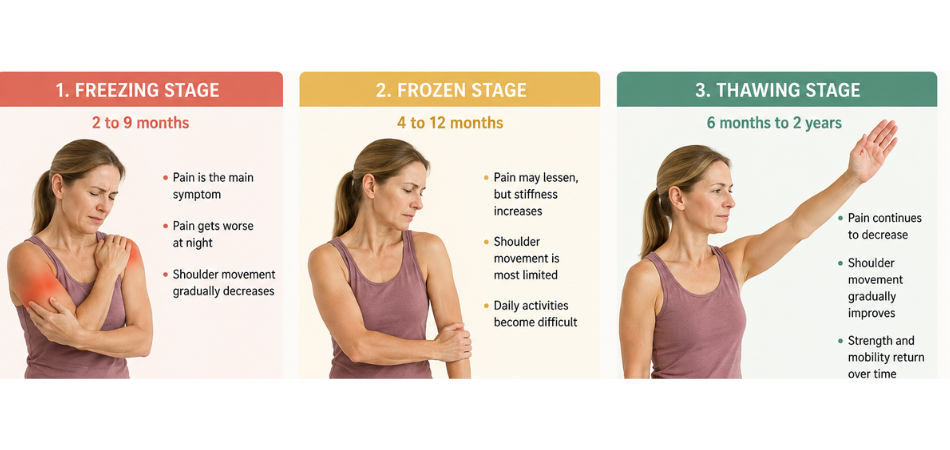
1. The Freezing Stage
Duration: Approximately 2 to 9 months
During this stage, inflammation increases within the joint capsule
You may notice:
- Persistent shoulder pain
- Pain that becomes worse at night
- Difficulty sleeping on the affected side
- Gradually decreasing shoulder movement
- Pain during everyday activities like reaching or dressing
Although stiffness begins during this phase, pain is usually the most significant symptom.
2. The Frozen Stage
Duration: Approximately 4 to 12 months
As inflammation begins to settle, pain often becomes less intense, but stiffness becomes much more noticeable.
Common symptoms include:
- Markedly restricted movement
- Difficulty reaching overhead
- Trouble fastening a bra or reaching into a back pocket
- Challenges washing or styling your hair
- Reduced ability to lift or carry objects
Many people find this stage the most limiting because of the severe loss of mobility.
3. The Thawing Stage
Duration: Approximately 6 months to 2 years
This is the recovery phase.
Gradually:
- Pain continues to improve
- Shoulder movement slowly returns
- Everyday activities become easier
- Strength and flexibility begin to recover
Recovery varies from person to person, and some individuals may continue to experience mild stiffness for some time.
How Osteopathy Can Help
At Hello Osteo, we understand that every frozen shoulder is different. Your treatment should reflect the stage you're in, your symptoms, and your individual goals.

Comprehensive Assessment
Not every painful shoulder is a frozen shoulder.
Conditions such as:
- Rotator cuff injuries
- Shoulder impingement
- Bursitis Arthritis
- Referred neck pain
can produce similar symptoms.
Our osteopaths perform a detailed assessment to identify the underlying cause of your shoulder pain, ensuring you receive the most appropriate care.
Gentle, Stage-Specific Treatment
Because frozen shoulder changes over time, treatment should change too.
Depending on your stage, your osteopath may use gentle hands-on techniques to:
- Reduce muscle tension
- Improve joint mobility
- Encourage healthy movement
- Support circulation
- Help ease discomfort
In the early stages, treatment focuses on managing pain and protecting the joint. As recovery progresses, treatment gradually shifts toward restoring movement and improving function.
Personalised Home Exercises
Recovery doesn't stop when you leave the clinic.
We'll provide simple, easy-to-follow exercises designed specifically for your stage of recovery. These movements help maintain mobility, reduce stiffness, and support long-term improvement; without aggravating your symptoms.
Consistency, rather than intensity, is often the key to successful recovery.
When Should You Seek Treatment?
It's worth booking an assessment if you:
- Have shoulder pain lasting more than a few weeks
- Notice increasing stiffness
- Can't comfortably lift your arm overhead
- Have pain that's disturbing your sleep
- Find everyday tasks becoming increasingly difficult
Early assessment can help identify the cause of your symptoms and guide you toward the most appropriate management plan.
Frequently Asked Questions
Can frozen shoulder heal on its own?
Yes. Frozen shoulder often improves over time without surgery, but recovery can take anywhere from 1 to 3 years. During this time, pain and stiffness can significantly impact daily life. Seeking treatment early may help manage symptoms, maintain mobility, and support a smoother recovery.
How long does frozen shoulder last?
Frozen shoulder typically progresses through three stages:
- Freezing stage: 2–9 months
- Frozen stage: 4–12 months
- Thawing stage: 6 months to 2 years
The exact timeline varies from person to person, and some individuals may experience mild stiffness even after recovery.
What causes frozen shoulder?
The exact cause isn't always known. However, frozen shoulder is more common in people who:
- Are between 40 and 60 years old
- Have diabetes
- Have thyroid disorders
- Have recently had shoulder surgery or an injury
- Have kept their shoulder immobilized for an extended period
Is frozen shoulder permanent?
In most cases, no. Most people gradually regain much or all of their shoulder movement over time. Some individuals may experience mild, long-term stiffness, but severe permanent loss of motion is uncommon.
Should I exercise a frozen shoulder?
Yes...but gently.
Appropriate stretching and mobility exercises can help maintain movement and reduce stiffness. However, exercises that cause significant pain may worsen symptoms. It's important to follow exercises that are appropriate for your stage of recovery and your individual condition.
Can osteopathy help frozen shoulder?
Osteopathy cannot instantly "cure" frozen shoulder, but osteopathic treatment may help manage pain, improve joint mobility, reduce muscular tension, and address compensatory movement patterns that develop as the condition progresses. Your osteopath will tailor treatment according to the stage of your frozen shoulder and your individual needs.
How is frozen shoulder diagnosed?
Diagnosis usually involves:
- A detailed medical history
- A physical examination
- Assessing both active and passive shoulder movement
In some cases, imaging such as X-rays or MRI may be recommended to rule out other causes of shoulder pain.
When should I see an osteopath?
You should consider booking an assessment if you have:
- Shoulder pain lasting several weeks
- Increasing stiffness
- Difficulty reaching overhead or behind your back
- Pain that's disturbing your sleep
- Reduced ability to perform everyday activities
Early assessment can help determine whether your symptoms are due to frozen shoulder or another shoulder condition requiring different management.

Take the First Step Toward Better Shoulder Movement
Living with frozen shoulder can be frustrating, but you don't have to simply wait for it to improve on its own.
With the right assessment, hands-on treatment, and personalised rehabilitation plan, many people are able to manage their symptoms more comfortably and regain confidence in their movement.
If shoulder pain or stiffness is affecting your daily life, our team at Hello Osteo is here to help.
Whether you're in the early painful stage or well into recovery, we'll work with you to create a treatment plan tailored to your needs.
Book an appointment at our Kingston or Amherstview clinic today and take the first step toward moving more freely again.
Book at Our Kingston or Amherstview Clinic
Disclaimer: This article is intended for educational purposes only and should not be considered medical advice. If you are experiencing persistent shoulder pain, loss of movement, or worsening symptoms, please consult a qualified healthcare professional for an appropriate assessment and treatment plan.
References
- American Academy of Orthopaedic Surgeons. (2024). Frozen shoulder (adhesive capsulitis). https://orthoinfo.aaos.org/en/diseases--conditions/frozen-shoulder
- National Health Service. (2023). Frozen shoulder. https://www.nhs.uk/conditions/frozen-shoulder/
- Mayo Clinic. (2024). Frozen shoulder. https://www.mayoclinic.org/diseases-conditions/frozen-shoulder
- Kelley, M. J., McClure, P. W., & Leggin, B. G. (2009). Frozen shoulder: Evidence and a proposed model guiding rehabilitation. Journal of Orthopaedic & Sports Physical Therapy, 39(2), 135–148. https://doi.org/10.2519/jospt.2009.2916
- Lewis, J. (2015). Frozen shoulder contracture syndrome – Aetiology, diagnosis and management. Manual Therapy, 20(1), 2–9. https://doi.org/10.1016/j.math.2014.07.006
- Zuckerman, J. D., & Rokito, A. (2011). Frozen shoulder: A consensus definition. Journal of Shoulder and Elbow Surgery, 20(2), 322–325. https://doi.org/10.1016/j.jse.2010.07.008
Ready to take the next step?
Our osteopathic treatments are tailored to your body and goals.
Learn more about our services ->